
A story of hope: meet the founder of Forgotten Women
Sunny Bahia: charity founder - London, UK
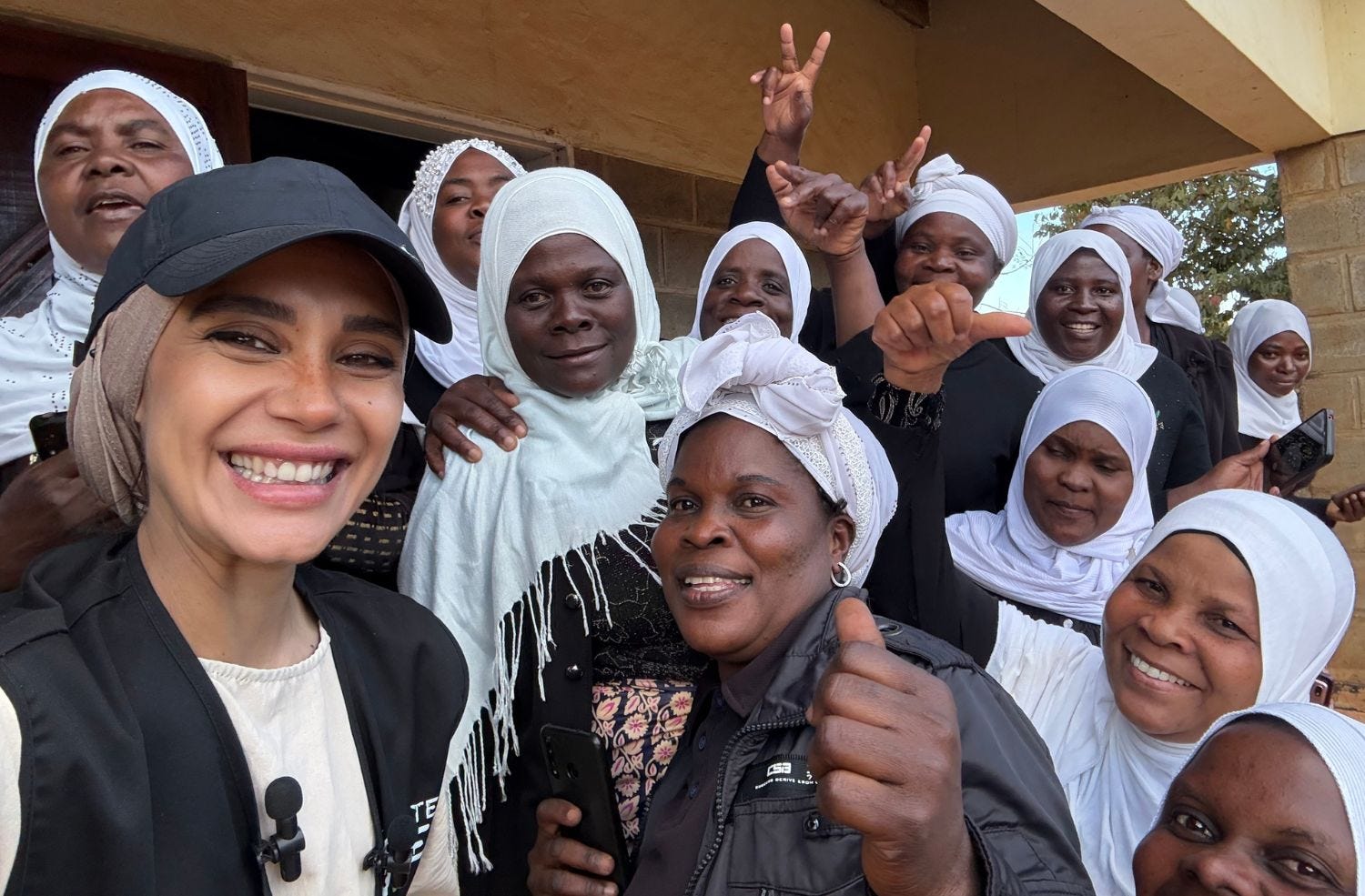
(Rather listen to the full conversation with Sunny? Here you go!)
Please note, this article contains potentially distressing content.
“In these countries, when a man isn’t present, a woman doesn’t have a voice. She’s vulnerable and will do anything – absolutely anything – to feed her children. I’ve had cases of women who’ve become pregnant by an aid worker while trying to receive aid. And it doesn’t stop there. We’ve had cases in Syria where children as young as nine have been asked to do sexual favours for a bar of soap.”
Sunny Bahia founded Forgotten Women in 2013. It’s a charity that supports vulnerable and marginalised women around the world, by protecting their dignity and helping them escape poverty and exploitation. And it’s vital work. In a disaster zone, women are 14 times more likely to die than men. When it’s literally a battle for survival, they sometimes have to go to extreme lengths to receive life-saving supplies – first for their children, and then for themselves. “A lot of people aren’t aware that sex for aid exists,” Sunny says, “But it happens all round the world.”
Over the past 13 years, Forgotten Women has helped tens of thousands of women across the world experience dignity, safety, hope and the chance of a better future.
An unexpected calling
But back in 2011, Sunny was living a very different life.
“I was a creative – I know that’s hard to believe!” she laughs. “I come from a design background – graphic design, editing, all of that…I kind of had my life planned out, if I’m honest. I was going to work my way up the ladder, set up my own design company, and then buy a house and a nice car – all of that and more.” Living her dream in London, times were good, “I really, really used to enjoy it!” she says.
And then the war broke out in Syria. For some reason, Sunny couldn’t look away. The images of suffering – particularly the women – kept playing in her mind, on a loop. “You know how sometimes you can’t unsee or unhear something? When I went to bed, I could hear the screams of those women. I couldn’t switch it off.”
She felt she had to do something – but was at a loss for what could genuinely help. So she trawled through Facebook. “It took some effort – social media back then wasn’t what it is today – but I got in touch with some people doing great work on the ground.” She ended up talking to a married couple – aid workers in Syria, “And they said there was real need for a women’s hospital because there was just one midwife covering five districts.” With little to no medical support, women were frequently dying in childbirth, right in the middle of a war zone.
Building a hospital seemed like an excellent solution, so Sunny spent all her spare time working with the couple on a fundraising plan, “Until one day they just went silent.” She never heard from them again.
“Until this day, I have no idea what happened,” she says, “I’ve tried to find out. No one knows. I think they died in crossfire because they were in Damascus, and during that time things changed very quickly. And that was it.”
Seeing suffering beyond Syria
Having felt such a strong pull to help, Sunny was suddenly adrift. So, she packed up her camera equipment and went travelling. “I do photography as a pastime, and from behind the camera – when you don’t have a voice, when you’re not speaking, when you’re just observing – you realise that women are really suffering in other countries as well. It’s not just Syria.”
Once back in the UK, she began looking for new ways to help. “I spoke to a few charities, because I didn’t want to start something that already exists. We might as well just pile our efforts there.” Yet the feedback she kept getting was there was real need for a dedicated women’s charity, because when aid is being handed out, “Women are sidelined. Women don’t get the aid. Women are last to get the aid.” And there were many stories about sexual exploitation and violation of human rights – at the hands of the men who were supposed to be helping.
This was Sunny’s tipping point. With so many countries affected by conflict, disaster or emergencies, there was a clear need for an exclusively female front-line team who could deliver life-saving supplies directly to the affected women. “I thought to myself if we want the world to change, we’ve got to be the change. It’s now or never.”
Humble beginnings
“I met my friend Lucy in a coffee shop and said we’ve got to do this…It’s a moral duty.” Lucy was on board. Then they met Ali, who was inspired to join the team. “And that was it – that was the birth of Forgotten Women.”
Despite never having worked in the charity sector, Sunny quit her corporate job and threw herself right in, setting up a charity fund and getting registered. “It was well scary – we didn’t know what we were doing! Our first offices, honestly, I can’t tell you, it was like… Oh gosh… humble beginnings, right?!”
As Sunny says, this was a “major lifestyle shift”. While it was a sacrifice they were all willing to make, the reality still came as a shock. “I’m going to be honest; it was really tough in the beginning. We had this great energy but were in this really tiny office – three of us crammed in asking ‘How do we get our message out there? How do we get people to support us?’”
With no experience in the sector, they were learning from scratch. And it took its toll. “One time, we nearly killed each other!” she jokes, “It was just frustration, because I think we all had this energy, this passion to help women, but it wasn’t coming together.”
But grit and perseverance eventually paid off. Things started to take shape. They successfully completed their first safe aid delivery in Syria. And the snowball started to roll.
When you can’t just walk away
This radical shift in direction had surprised everyone in Sunny’s life – including herself, “I wasn’t that type – if something bothered me, I’d usually just walk past it. But something had changed.” This was far bigger than starting a new career: she’d found her calling – a visceral drive to make the world a better place.
“Perhaps I’m getting too personal, but I have a lot of regrets in life, and I just thought to myself I don’t want this to be another regret, you know. It’s hard living with regret.” She couldn’t walk away.
Initially, her family wasn’t entirely on board, “I think parents have certain expectations of their children, don’t they? To become doctors or whatever. And I’d just completely gone against the grain!” She laughs, “All of a sudden, I’ve chucked in my job and am doing charity work. It was like, ‘Oh my God has she gone mad? What the hell has happened to her – is she going through a midlife crisis?’”
But this was short-lived, and their ongoing support has meant everything, “I’ve realised how important family is,” she says. Perhaps this feels particularly poignant now she’s working with women who don’t have anyone in their corner.
Safe aid and advocacy
Over the years, Forgotten Women’s reach has expanded beyond Syria to include Somalia, Malawi, Pakistan, India, Bangladesh, Yemen and most recently Gaza. And its core mission has grown as well.
The charity has become a global voice for women who have been silenced. By raising awareness of what’s happening around the world – and highlighting instances of systemic exploitation and violation of human rights – they are making sure these women will no longer be ignored.
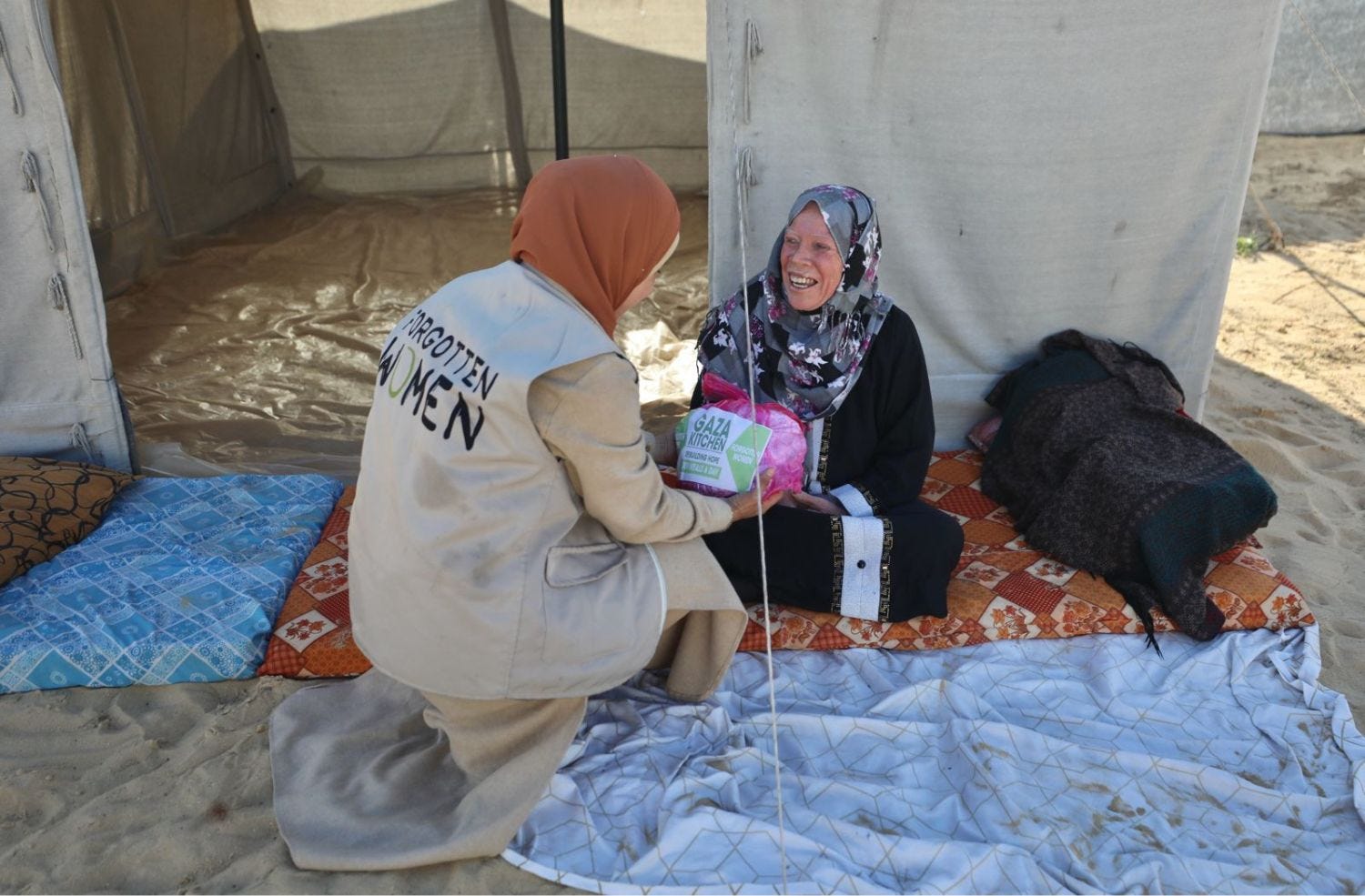
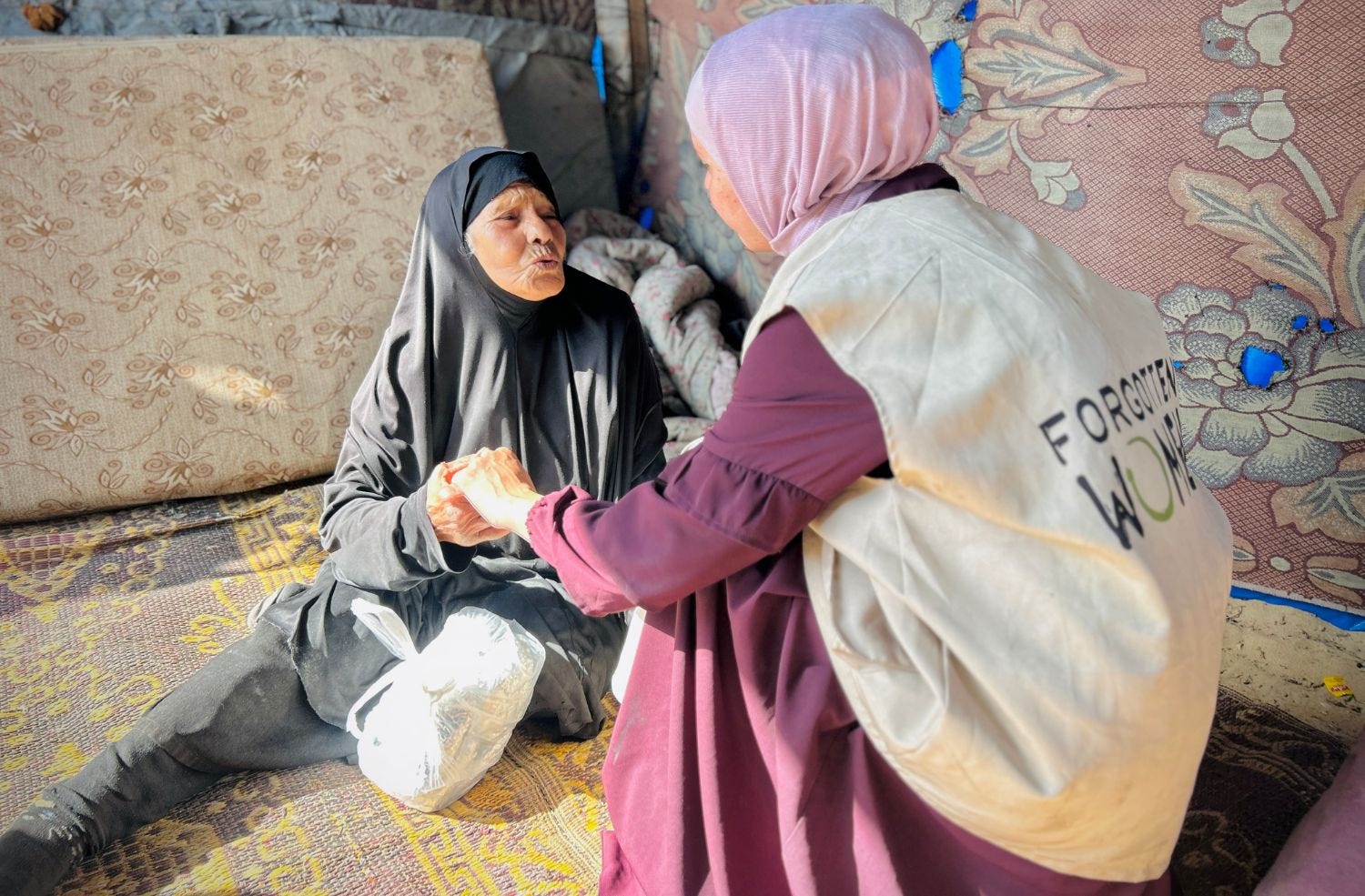
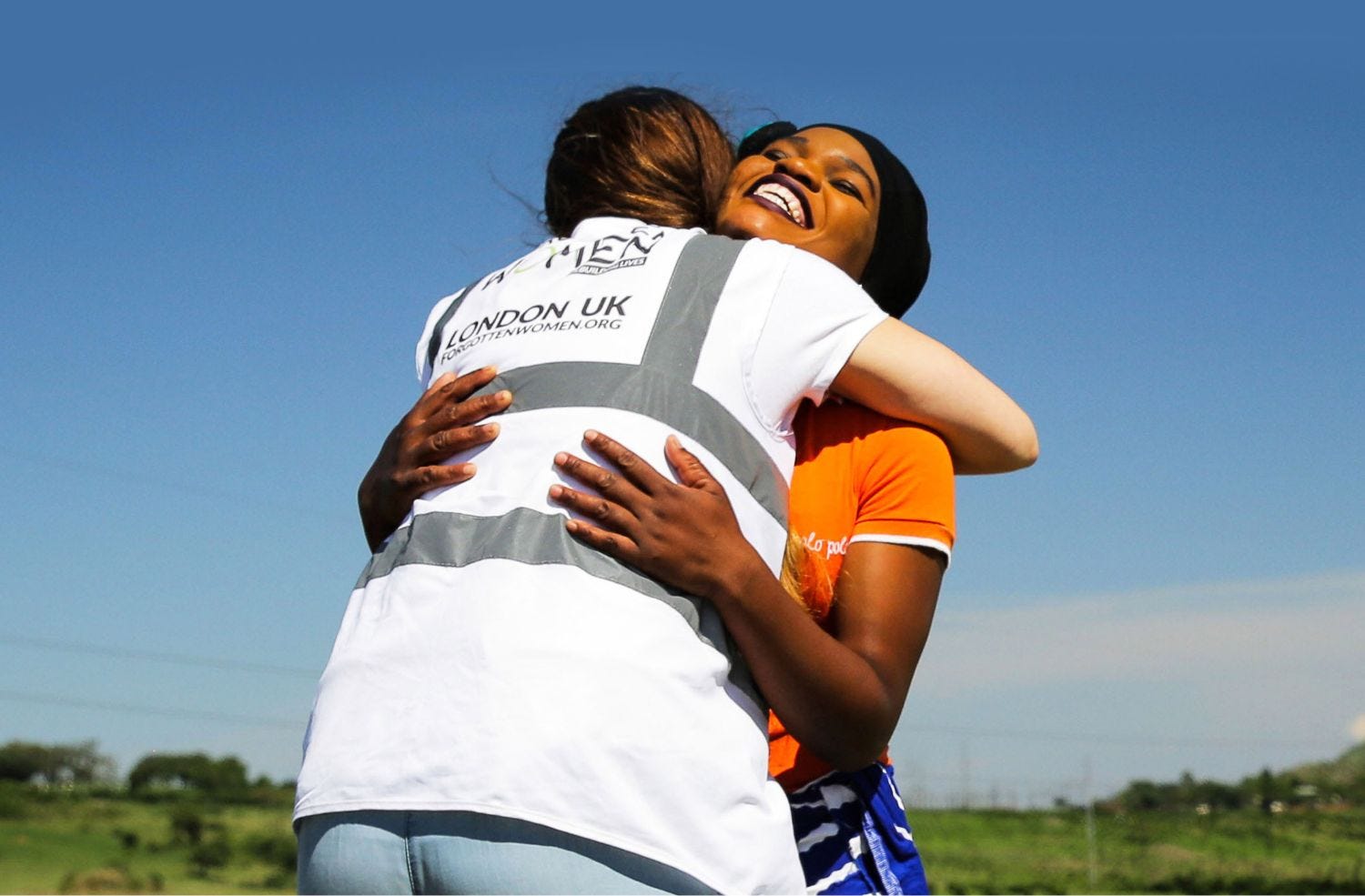
Delivering emergency aid provides more than just vital supplies. “We try to do an outreach service where we deliver aid to women in their tents. So, if they want to talk about anything they’re going through, they can,” says Sunny. And if the team can’t do this, they’ll still make the time for vital human connection. “We make sure we hug each woman – I’ve been to distributions where I’ve hugged over 500 and asked every single one if she’s okay.”
These brief moments of compassion hit home, “When you embrace that woman – when you hug her, when you kiss her on her cheek – she doesn’t want to let go.” As Sunny says, “I think it’s so important for her to have that moment, because she’s not going to have it again. As soon as I take my arms away from her, she’s back on autopilot – being the warrior who takes care of the children.”
Breaking the cycle
Although emergency safe aid was the original focus, the team quickly noticed a similar pattern happening in post-conflict countries. Once a country has stabilised, women who’ve been widowed and left in sole charge of their children, or those ostracised through disability or disfigurement, are dependent on handouts. In these cases, they’ll do whatever it takes to survive – begging, prostitution, selling an organ, or even selling a child.
She recalls Tahira in Afghanistan. Sunny met her shortly after Tahira’s husband was killed in crossfire. Not only was she dealing with grief, but she also had four young children to feed, was pregnant with her fifth, and desperate for food. “We went to her house and – oh, God – it was so cold. There was no food. It was really basic.”
Someone had just offered to buy her four-year-old daughter, Mahnaz, for $500. A welcome respite from poverty, but at the worst possible cost. Sunny remembers, “She kept saying, ‘There’s no helping me. There’s just no helping me.’”
This isn’t a one-off story – it’s why Forgotten Women expanded its mission. “We thought we need to empower these women; we need to protect their dignity. How can we do this? Handing them businesses – why not!”
So, they developed a model that turns financial donations into long-term independence: lifting women out of the aid cycle, out of poverty, and out of despair. Caseworkers identify women they can help, and the charity works with them to develop a business plan that complements their skillsets and will deliver a profit. Then it buys them the components they need to get started. This isn’t just a lifeline for now, it can change lives for generations to come, “We’re trying to break the cycle of poverty,” says Sunny.
Tahira’s transformation
And for Tahira, it’s changed everything. She now manages a successful transport and courier business, employing her uncle to drive the van – lifting him out of poverty, too. Sunny visited her again 18 months later, “And I kid you not, I didn’t recognise her because she’s put on weight! Her children were dressed in warm clothes. She had electricity. She’s even taken up rug making as a hobby – not to make a profit, it’s just a hobby!”
Seeing the impact first-hand brought home to Sunny how vital the work she’s doing truly is, “The UN talks about it all the time – the fastest way to eradicate poverty is to empower a woman as they’ll build communities. But when you actually see it in action, it’s something else.”
But the biggest joy was seeing Mahnaz was again. She hadn’t seen her since they’d handed over the keys to Tahira’s van when, “Mahnaz grabbed her mum’s dress and said, ‘Mummy, Mummy, you don’t have to sell me now.’ It broke my heart. It absolutely broke my heart.”
The true cost of living your purpose
Sunny can’t remember her last proper holiday. Whenever she travels, it’s for work. She books 16-hour flights in economy to save money for the charity’s beneficiaries. Her days start at 6am and don’t end until 11pm – when she opens her laptop to manage the UK team. “I’ll be honest with you, it’s really tiring and draining,” she says, “And there are weeks like that. You don’t get any rest time, you’re working till the last minute, experiencing all these highs and lows. And then you come back and go straight into the office the next day.”
So, does this work come at a cost? “I think I’m so damaged, I don’t realise it!” She’s only half joking. After all, she’s witnessed more suffering than many of us will ever see, “And you’ll always remember it. One of the things I always say is you can’t unsee things. And sometimes you wish you could. Because it’s just painful.”
Yet while she’s passionately advocating for change, others would rather not know. “I’ve been at fundraising events talking about a woman who’s been raped in order to receive an aid box, and someone has stood up and said, ‘I don’t want to hear about this – I’ve come here for a good time.’” It’s impossible not to react, and Sunny’s no exception. She grimaces, “I think I lost my composure…”
Long gone are the days of her two-seater sports car, “I’ll just have to find a rich man,” she laughs. She now feels uncomfortable overspending or going to lavish places, “It’s really conflicting,” she says. Instead, joy is found in life’s more private moments, “I just love sitting in a coffee shop with a cup of coffee and reflecting. I love spending time with my little nephew, my little niece, my family – the important things.”
Would she go back to her life before? It’s a firm no. “I don’t think I could do anything else,” she says, “I honestly believe we should live our lives being a vehicle for other people”. She’s found her purpose, her life makes sense to her, and she knows she’s making a difference. Importantly, she’s motivated by what truly matters to her – and this keeps her going through the hardest days. “People working in the charity sector don’t have great lifestyles, but it’s a sacrifice you have to make. You have to see it through.” At the thought of returning to the corporate world she says, “I think the guilt would eat me up.”
The ripple effect
Looking to the future, Forgotten Women isn’t planning to expand into more countries – they’re already at eight and “we want to focus on quality over quantity”. Instead, the priority is clear: to help more and more women build sustainable businesses and break the cycle of poverty.
In finding her own purpose, could Sunny be enabling countless other women to find theirs too – by setting up businesses they genuinely want to run? “Wow! I’ve never really thought about that; I’ve never connected the two. Gosh, yes, I guess so!”
In turn, these women are showing future generation what’s possible. As they begin to thrive – not just survive – they won’t just rebuild their own lives, they’ll transform their communities too. This is prosocial behaviour in action, and the potential ripple effect is staggering.
Forgotten Women will continue to provide life-saving supplies on the front line, too. “Obviously, the world is in a terrible place at the moment,” says Sunny, “So we’ll keep delivering aid to the countries that need it. That’s really important. And we won’t stop until every woman gets the respect and dignity she deserves.”
Forgotten Women relies on donations and volunteers to continue this vital work. If Sunny’s story has moved you, please consider doing what you can to help.
You can find out more or get in touch through their website, or follow them on Facebook, TikTok, Instagram and YouTube.
Uncut and unfiltered: the full conversation
Want to hear more of Sunny’s story? This full conversation is beautifully unscripted - going deeper into the emotional reality of working on the front line, from learning to hold back her own emotions to autopiloting through trauma, and how working in this sector “softens your heart”.
If you prefer a linear story, stick with the article; if you like genuine streams of consciousness, you’ll hear her humility when talking about Forgotten Women’s impact, laugh about needing to find a rich husband, and the weight of everything she’s witnessed.