
Marathon Dan: the long-distance runner who hates his sport
Daniel Angel: MND fundraiser - London, UK
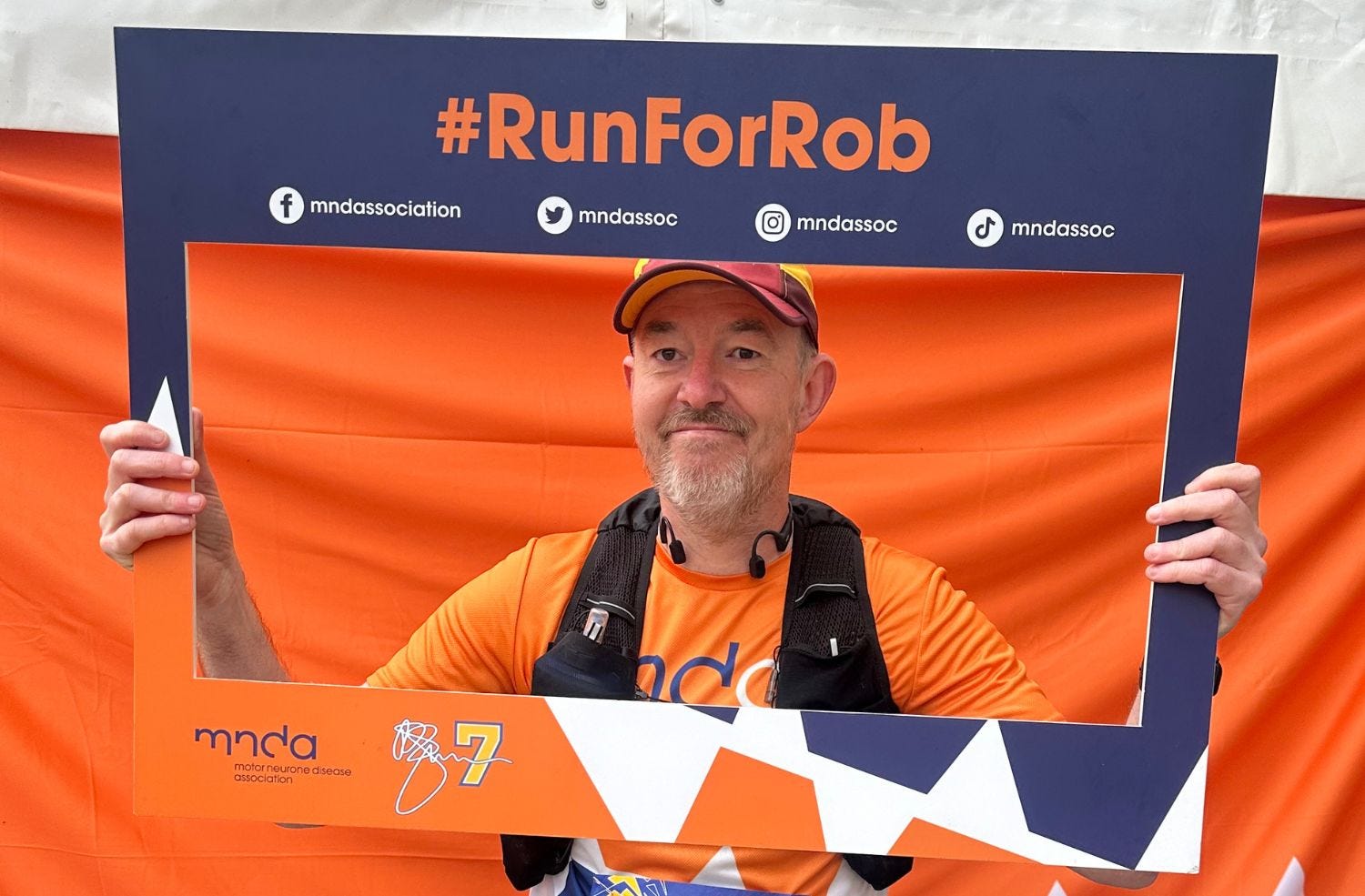
(Please note, this article contains some strong language. Rather listen to the full conversation? Here you go!)
“Why would anyone want to do this?” asks Dan Angel. “I honestly don’t understand why people like it. I don’t even get any buzz afterwards either.” What, no endorphins or runner’s high? “No. It’s just bollocks. I don’t think they exist. I think people have made these things up.”
In memory of his late father, Peter, Dan’s hoping to complete 26 marathons over the next decade and raise £100,000, primarily for the MND (Motor Neurone Disease) Association. But he hates running. “If you’ve got enough determination, you can do it. But don’t bloody ask me if I enjoy it.”
15 years out of the gym
Dan only started running in November 2023. “Prior to that, I hadn’t been in a gym for 15 years,” he says. Before then, his free time was dominated by culture. “I’m a massive opera fan, I’m a member of Ronnie Scott’s, I go to loads of art exhibitions, I’m a massive heavy metal fan so I go to rough gigs in Camden, I read all sorts of books,” he says. “My wife, Gemma, is always worried when I pick up something new because she thinks I’ll want to know everything there is to know about it. I’ll find new hobbies on a monthly basis and want to become a knowledge expert on them.”
But things changed just before he turned 50 when he saw Kevin Sinfield – an ex-rugby league player – on TV. Kevin was running marathons to raise money for the MND Association, in memory of his late teammate, Rob Burrow, who died of the disease. “Rob played for Leeds Rhinos and was the number seven. So all of Kevin’s charitable efforts are around the number seven”, says Dan. “Every year he does a ‘7 in 7’, which is seven marathons in seven days.”
This sparked an idea for yet another hobby – this time one with a greater purpose: running a marathon. “Because I had no knowledge of what running a marathon was like I thought, ‘That doesn’t look too bad. You see blokes doing it with fridges on their backs and dressed as rhinos. Surely I could do it too?’”
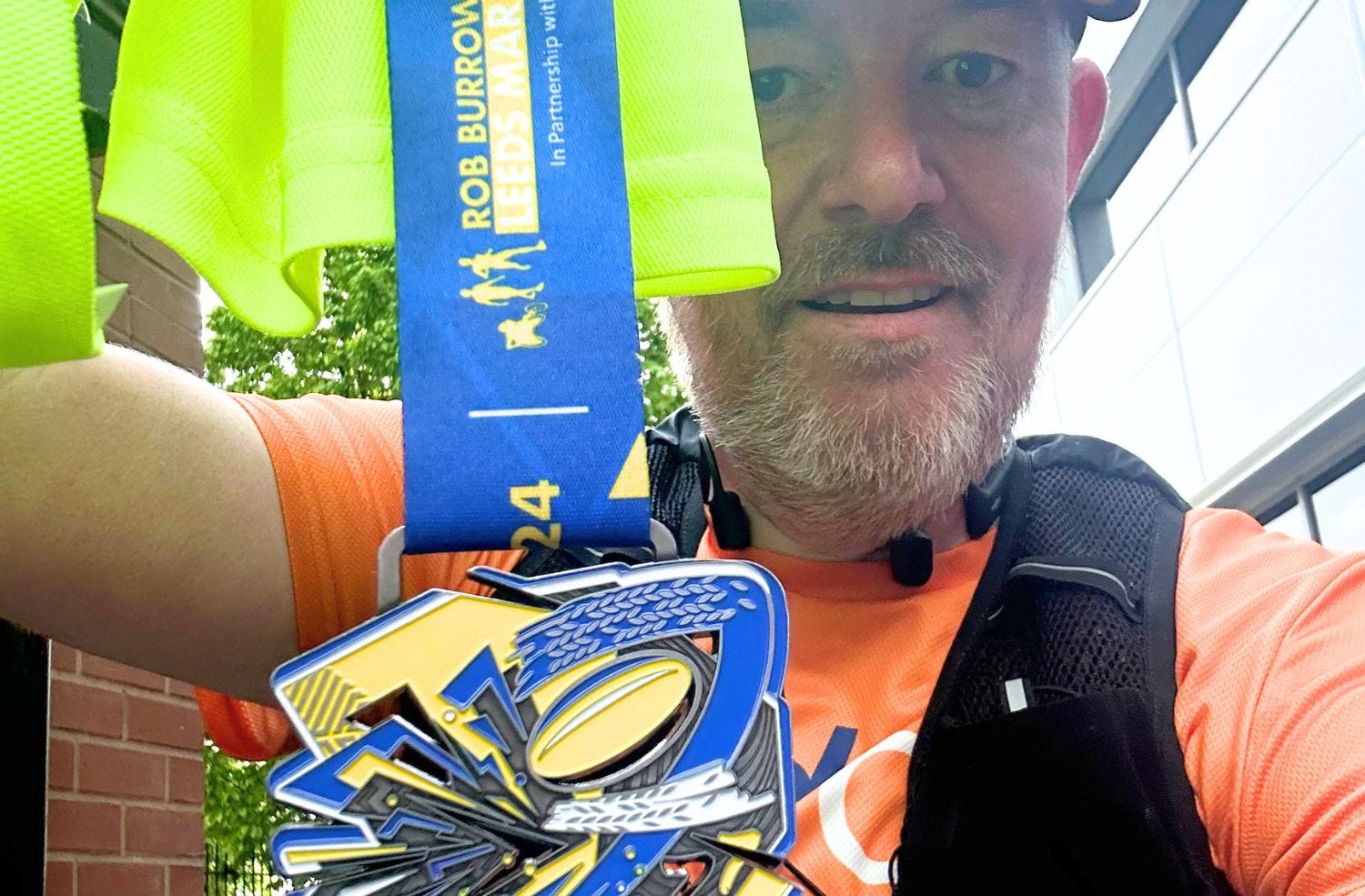
With the support of his family (and Gemma assuming this was just another passing fad) Dan promptly signed up for the Rob Burrow Leeds Marathon, on a mission to raise money for MND too.
A brutal diagnosis
“My father died from Motor Neurone Disease,” says Dan. “He was 62.”
A year before, Peter had started tripping up. Initially, they didn’t think anything of it; we can all be uncoordinated at times, “I mean, I’m notoriously clumsy. I’m always banging my head,” says Dan. But when this continued, Peter went for tests. “I was in the room, when he was diagnosed,” Dan remembers.
“The thing that sticks in my memory about it all, was that the doctor said to him – more or less word for word – ‘We’ve done some tests. And the good news is we’ve ruled out Parkinson’s, but unfortunately it looks like you’ve got Motor Neurone Disease.’”
While there’s never a good way to deliver bad news, this was brutal. “If I was being generous, maybe he was inexperienced. But it was pretty rubbish.”
The disease progressed quickly. MND attacks the nerve cells that control movement. Gradually, messages from the brain and spinal cord stop reaching the muscles and everything shuts down: from limbs to speech, swallowing and breathing. Yet the mind stays sharp. In the UK, six people are diagnosed with MND every day. And six people also die from MND every day. There is currently no cure.
A year to the day
For Dan’s family, the unexpected kindness of friends was a genuine lifeline. Peter’s oldest schoolfriend, a builder, drove over every day until he’d single-handedly built a new downstairs extension so Peter could stay at home for as long as possible. “He was a titan,” recalls Dan. “You see the best parts of human nature in these times.”
The family did the lion’s share of care, with professional carers helping once Peter couldn’t move. Peter passed away in a hospice, just a year after diagnosis. “More or less a year to the day,” says Dan. Sometimes the disease moves more slowly, but Peter’s was quick. “I wouldn’t have wanted to see him linger on. It was a blessed relief at the end, to be honest.”
A painful first marathon
Signing up for a marathon was about more than just raising money for the MND Association – the main charity supporting people affected by MND – it was a way for Dan to honour his dad’s memory. But it wasn’t easy, “I started running and found out that a mile was a lot more difficult than I ever imagined!” He admits he should have done a bit more research before committing. Not least seeing if he actually liked running – which, it turns out, he hated.
“I’m a fucking idiot,” he says, “There wasn’t enough thinking it through beforehand.” If he could have his time again, “I’d have chosen something else. I’d have sold things on the street, I think, rather than do this!” So, what keeps him going? Not external rewards, clearly, but something deeper. “There are points on every run where I concentrate on why I’m doing this. I think of my dad, sitting in the chair, not being able to move. I think of the hoist. I think of him in the hospice towards the end. And I use that to drive me on.”
Fitting training in around his family, his full-time job and his love of culture wasn’t easy. But he braved the cold, dark, wet winter mornings and gradually racked up the miles.
Just sixteen weeks later, having raised nearly £7,000, he headed up to Leeds for marathon day.
Then disaster struck. Halfway round the course, a woman ahead of him stumbled – and Dan badly twisted his ankle avoiding her. He texted his family to let them know what had happened – but kept going. “They were all telling me to stop,” he recalls, but he refused. “It’s not possible for me not to finish. If I broke an ankle, I’d finish. Gemma wouldn’t like to hear me say that because she knows what I’m like, but I would hurt myself to finish. I would.”
Pulling out a double measure of Jack Daniel’s – hidden in his running vest – at mile 25, may have helped numb the pain. “I decided to record a video near the end and toast my dad,” he says, “Although the mistake I made was doing it so far from the finish line. I had terrible heartburn for the last mile.”
Dan barely registered the cheers as he neared the end. “I don’t really get any benefit from being supported. Because, mentally, I’m in the place I need to be.” He was locked in his pain cave, using his dad’s memory to push through.
Eventually, he “sort of stumbled across” the finish line. “I thought I’d made decent effort in the last 50 metres, but frankly I looked like an arthritic 90-year-old.”
No one’s dancing down the road
The next day was worse. Travelling solo and barely able to walk, Dan gritted his teeth and spent five hours on public transport getting home. And then he spotted a blind man at Twickenham station. “I thought I’ve got to ask him if he needs help.” Unfortunately, the man said yes. “I said, ‘You can’t see, but I’m going to be a bit slow because this is what’s happened’. He said, ‘Oh, don’t worry. I’m not exactly Fred Astaire dancing down the road myself!’ So, I had to walk a blind man, with his arm around me, and deposit him at a café – while crippled and dragging my case in the other hand.”
By day two, he could hardly move. “My body was a wreck,” he says. “You have to think strategically. You have to ask yourself, ‘Do I need to go for a wee?’ You don’t want to sit down and then need to get up five minutes later. Because getting up and down is not good.”
One and done?
But while his body was moving slowly, his brain wasn’t. “There was part of me that felt I hadn’t done the best I could do, and somehow I’d let everyone down.” Gemma’s hopes for this being a one-and-done hobby were about to be dashed. “I felt guilty that I hadn’t raised any money for the hospice that looked after my dad,” he says, “Because they don’t get any government funding, and they were wonderful.”
Maybe he could run just one more marathon, and raise money for them too?
When they confirmed he had a place in that year’s London Marathon, “I was in the Southbank Centre and I burst into tears. People were thinking, ‘What’s wrong with him?’ But it meant a lot to me to run for them. A lot.”
So, like Twickenham’s answer to Forrest Gump, Dan continued training. Still hating every step; still driven by a strong sense of purpose.
Once again, on race day, he toasted his dad’s memory as he approached the finish line. And, once again, he’d raised nearly £7,000.
A measurable impact
While many people choose to run for large charities, Dan feels there’s a more directly measurable impact when you support smaller organisations, like MND and the hospice. “It seems to mean more to them,” he says. Small amounts make real differences: £10 buys an information pack for the newly diagnosed. £20 provides an LCD writing tablet so someone can communicate when speech fails. £4,000 kits out an entire family.
“I have experience of what stair lifts and hoists cost,” he says. “So, I like to think around £4,000 can kit a family out. Once I get to that number, I think I’ve helped.” He clarifies, “I know they don’t give it all to one family, but that’s the driving thing in my mind.” Knowing his suffering helps families in need gives Dan the grit to keep going – even when the path is painful.
A decade of pain
Having raised around £14,000, Dan could have easily hung up his running shoes for good. But he wasn’t done.
“Again, I blame Kevin Sinfield,” he says. “I saw him on television doing things that, frankly, I just can’t believe are possible. And then I thought, ‘I’m not doing enough. If he’s doing that, then I must be able to do a bit more. I’m not dead yet. I’ll do a couple a year until I get to 62 – which is the age my dad died.’”
Gemma understood how important this was and came up with an unexpected proposal. “She said, ‘Well, 24 is a funny number: you should do 26 because that’s the number of miles in a marathon.’ I thought, ‘Oh, Jesus!’”
That means 24 more marathons over the next decade – with a goal of raising at least £100,000 in total. “I’ll probably do 16 marathons for MND and then 10 for small local charities that mean something to me, like the hospice.”
To sweeten the deal, one race a year will be overseas – and Gemma gets to decide where they go, so they can turn it into a family holiday. But he’s painfully aware of his age, and the fact he still doesn’t see himself as a runner. “I’ve got to do three a year for the next couple of years,” he says. “The advice is to do a maximum of two, but I want to bank a few while I’m still relatively young, because I don’t want to be doing three when I’m 62!”
Get your fucking knees up
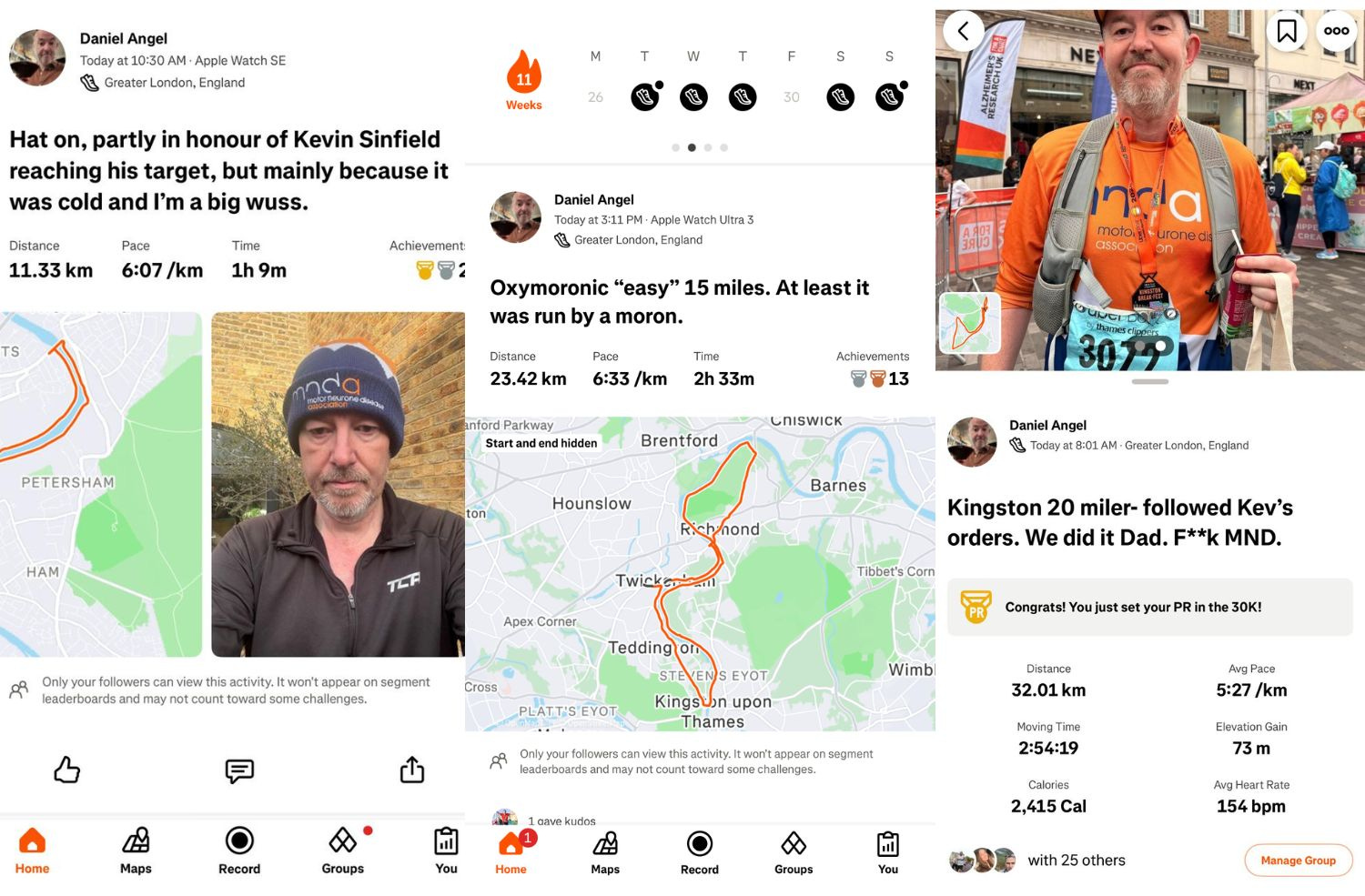
These days, Dan’s regime has ramped up significantly. He now trains seven times a week: two gym sessions and five runs, totalling more than 50 miles. “I ache all the time,” he says.
Masterminding this schedule is his new coach – an elite ex-marathon runner in his 70s who won’t take payment from Dan, as his gift to MND. “He follows me on a bike telling me to get my fucking knees up at 8am on a Saturday,” says Dan. “It’s like a Rocky movie.”
And he’s putting Dan through his paces in group training sessions too. “He sets me off first, for 60 seconds,” Dan explains. “And then I hear the rest of them like thunder coming up behind me. It doesn’t take too long to overtake me.” But they’re all very supportive. “They know how hard it is. The fact that you’re doing it is the main thing, as far as they’re concerned.”
Despite the punishing schedule, Dan wouldn’t have it any other way. He needs to feel the pain – and go to “dark places” – to keep reminding himself why he’s doing this. “It sounds a bit melodramatic,” he says, “But I always have tears in my eyes when I run. Not the whole way round, thank God. People would be worried if they saw me in Bushy Park doing that. But I do cry. I do.”
Meet your heroes
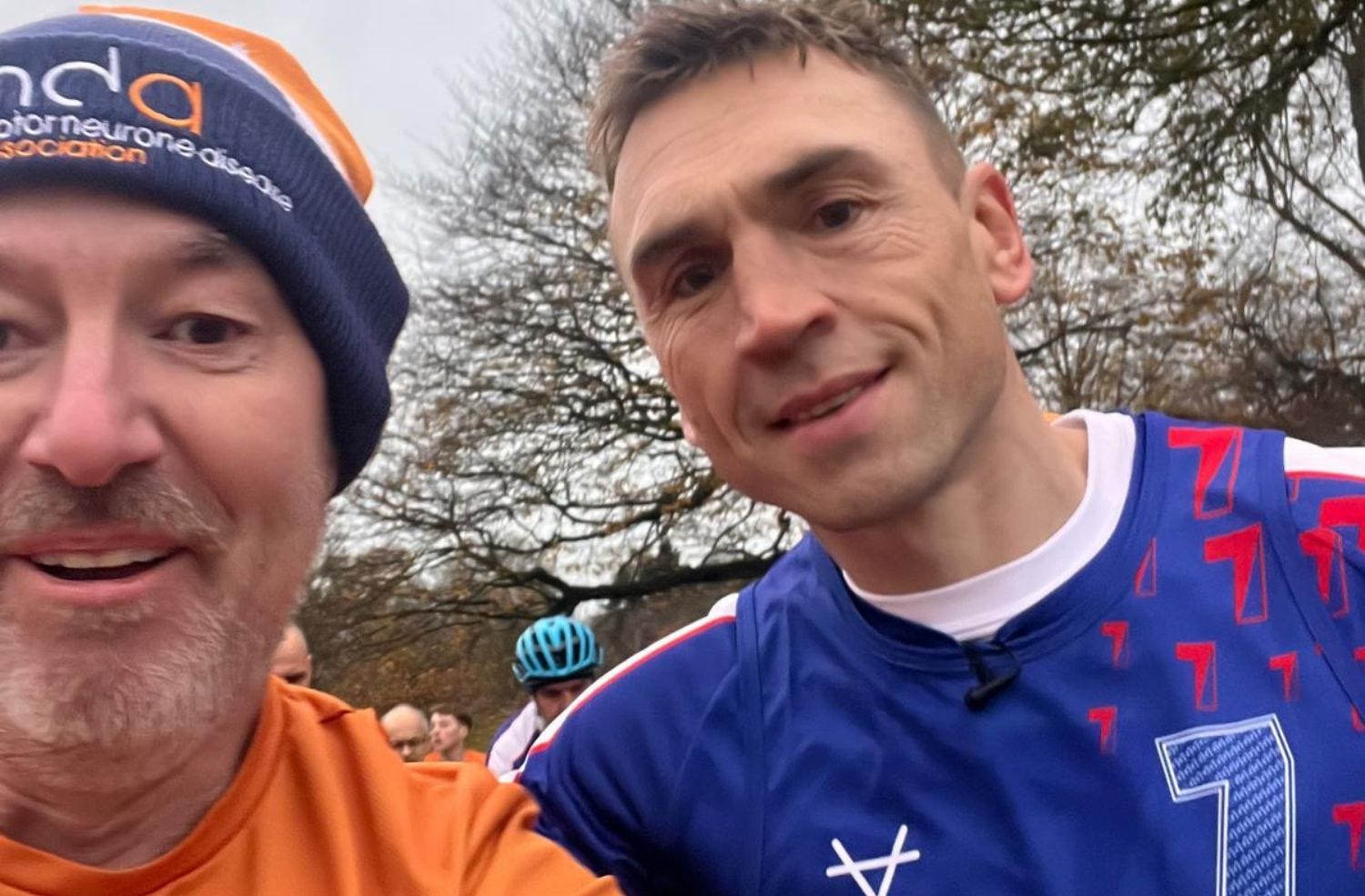
“There have only been two runs in my life that I’ve enjoyed, and that’s when I’ve run a mile with Kevin Sinfield.” Yes, Dan finally got the chance to meet the man who inspired it all.
During Kevin’s 7 in 7 challenges, he runs an ‘Extra Mile‘ for the MND community. It’s an opportunity to raise funds and awareness, and connect with the people he’s helping. “There might be 20 of us running with him, and 150 families there with MND,” says Dan, “And he speaks to every single one of them”.
The first time Dan took part was in Liverpool. “The embarrassing thing is, when I run with him, I can’t speak to him! Everybody else goes up to him and he asks why they’re doing it, but I haven’t got it in me to say anything other than ‘Thanks’.”
Afterwards, Gemma called to hear how it went, “I was on the train home. I couldn’t speak,” he says. “I broke down. I said to her, ‘I’ll call you back in a minute’ – and it took me about five minutes to compose myself. God knows what the people on the train thought!”
So, why does being around Kevin affect him so deeply? “It’s partly that he’s such a great man,” he says. “But it’s also connected with something that’s very important to me, and I can’t find the words.”
Kevin didn’t just inspire Dan to start running, he also inspires him to keep going when things get tough. “He doesn’t like it either – he’s not a runner,” says Dan. “I mean, he bloody is now, but it’s not something he gets any pleasure out of.” And much like Dan, Kevin doesn’t want the focus of the running to be about him – it’s about MND. Dan recalls a BBC Breakfast presenter asking Kevin how he pushes through the hard miles, “He touched his head and he touched his heart. He said, ‘It’s in here and it’s in here.’ And he didn’t want any more spoken about it,” says Dan. “And so, when I go running and it gets hard, I do that too: I touch my head and my heart. He helps me around even though he’s not there.”
Kevin’s given Dan the strength to keep going, even when things feel bleak. “Frankly, you’d go over the top with him,” he says. “You bloody would.”
Channelling grief into purpose
“I’ve got a sense of purpose in wanting to raise money and awareness for MND,” says Dan. Then he hesitates. “And I think I’ve got a complicated relationship with my dad’s death – helping MND through running has become a bit martyrish.”
One friend suggested it might be helping him process his grief. But Dan shakes his head, “I don’t want it to. I want it to remain raw – because if it doesn’t, I won’t get round.” He knows this sounds extreme. “The truth of it is, I want it to hurt. Because when I think of my dad and those last six months of his life, it was bloody awful. Flogging myself to death connects me to him, in a way. It makes me appreciate what he went through, and it drives me to carry on. If I didn’t have that, I wouldn’t do it.”
Of course, it’s also about the money he’s raising to help families, like his, after a diagnosis. “I say to people it’s all about the dough. And it is, mainly. But it’s about the dough in my dad’s memory.” He’s channelling grief into purpose, one painful mile at a time.
“So, I think I have got a sense of purpose – because it means a lot to me. Until a couple of years ago I would never have thought doing something like this would be important.” But now? “I would say, other than family, this is the most important thing in my life, without any doubt.” He bursts out laughing, “And it’s fucking terrible!”
The road ahead
Paris is just a few weeks away. Leeds is four weeks after that. Two marathons in one month. As Dan says, “That’s a bit stupid really.” Then he gets a bit of respite before Palma in October. By the end of this year, he’ll have completed 21 out of the 26. “I just focus on the next race,” says Dan. “I think if you start going beyond that, you’re not respecting what you’re doing.”
That said, he’s got his sights set firmly on the final finish line. Back where it all began in Leeds, in 2036. “I hope I can do all 26. But I also hope I finish when it’s done.”
There’s a pause. Will he really stop? “That’s what worries me,” he admits. After all, he never planned to run two marathons, let alone 26. “I might end up swimming the Atlantic or something. God help us all!”
Always there
Dan’s daughter, Romy, was only nine when he ran his first half marathon. He told her he’d looked up to the sky at mile 11 and asked his dad for a push. She waited to hear what happened. “He was no bloody use whatsoever!”
Yet in some ways he is always there, pushing Dan on. Every time he touches his head and his heart. Every time he thinks of Peter in the chair, unable to move. Every time he racks up another mile. Every time he toasts his memory just before the finish line. And in every pound he raises for a family who desperately needs it.
Dan won’t stop until he’s completed 26 marathons, raised £100,000, and proved that a fierce sense of purpose can take you further than you ever thought possible.
Even if you hate every single step.
If you’d like to support Dan, you can donate to MND Association through his JustGiving page. He’s currently the highest fundraiser for MND for this year’s Rob Burrow Leeds Marathon: let’s help keep him there!
And if you’d like to learn more about MND, access support, or share information with anyone who needs it, please visit the MND Association website.
Uncut and unfiltered: the full conversation
The article captures Dan's voice, but nothing beats hearing him tell his own story. In the full conversation, he opens up about his ongoing battle with injuries, why he always races under his dad's name, and how finding purpose has changed his view of human nature. Expect self-deprecating humour, brutal honesty, and a lot more swearing.